
Materials Science and Engineering Master of Science (M.Sc.)
Degree: Master of Science (M.Sc.)
Regular program length: 4 semester (full-time program)
Credit points (ECTS): 120 credit points
Language of instruction: German or English
Higher semester: no
Higher semester: winter and summer term
First semester: September 30 for winter term, March 31 for summer term
Higher semester: September 30 for winter term, March 31 for summer term
First semester: July 15 for winter term, January 15 for summer term
Higher semester: July 15 for winter term, January 15 for summer term
What you can expect in our master's program
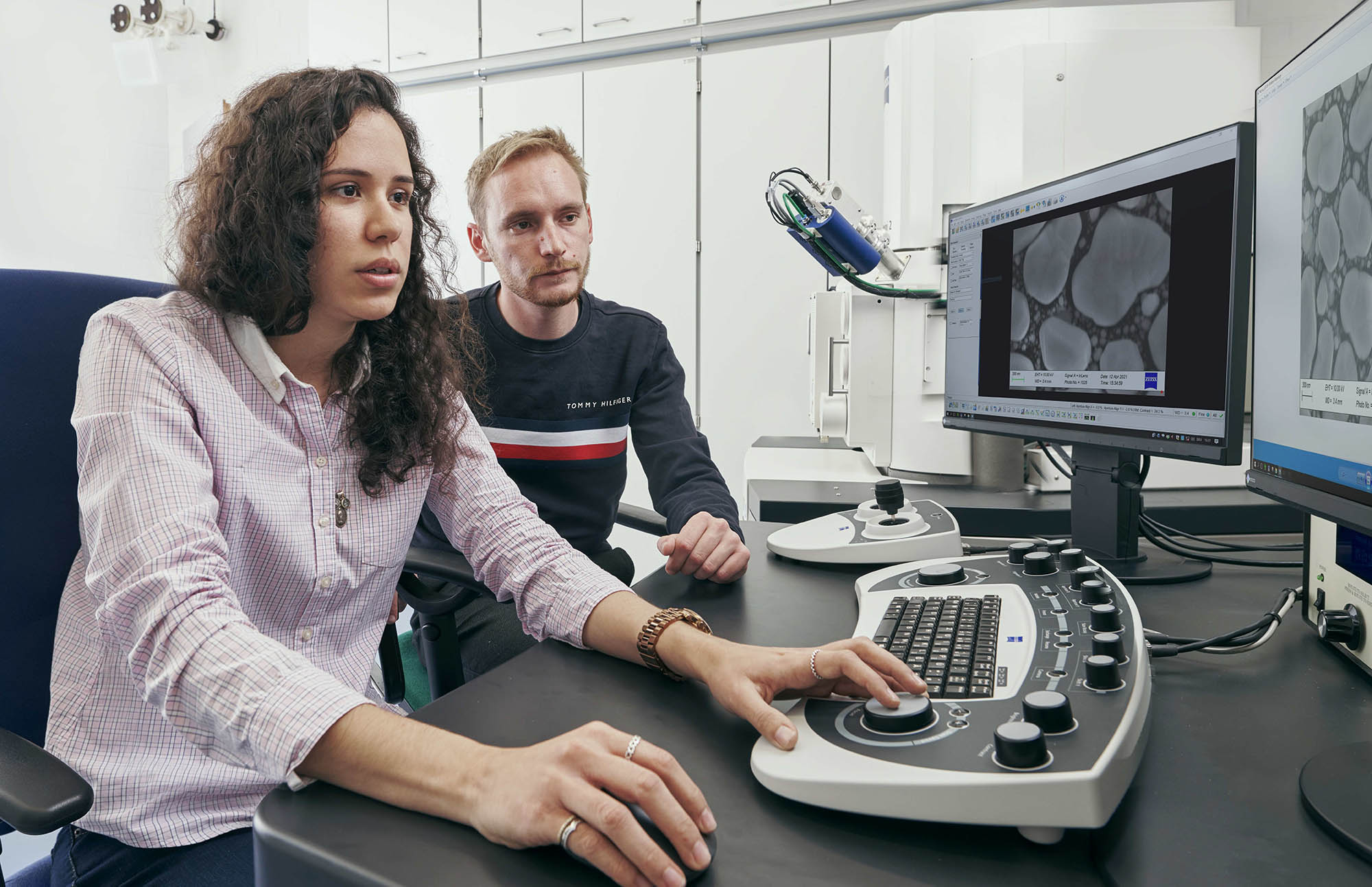
The master's degree program in Materials Science and Engineering combines technology with natural science in the search for ever better or even new materials and substances. The integration into the engineering sciences enables an overall view from the atomic structure to process technology through to application in a specific product. In the master's degree program, you will deepen the knowledge gained in a relevant bachelor's degree and can deepen your knowledge in one or two specialist areas. The program is designed to be research-oriented and also allows you to write a master's thesis in large-scale research. You can study this degree program entirely in German, entirely in English, or in a combination of both languages. Please note that each individual module is offered in only one language. You can find details in the module handbook.
Program structure
The degree program contains only a few compulsory subjects and a large area of in-depth study. STEM subjects and interdisciplinary qualifications are added as an "interdisciplinary supplement". The breakdown is as follows (in ECTS credit points):
- Materials Science Major Course (20 CP): you take the compulsory modules "Thermodynamics and Kinetics", "Simulation" and "Properties".
- Specialization (40 CP): one (40 CP) or two (2 x 20 CP) of the specializations:
- Structural Materials
- Computational Materials Science
- Functional Materials
- Structural Materials
- Interdisciplinary Complementation (18 CP)
In this subject, you can develop your personal and professional strengths. You will take a classic Interdisciplinary Qualification such as a language course or a course on presentation techniques. You will also strengthen your knowledge of the impact of your subject area on social issues. This subject is rounded off with elective modules from the STEM field.- STEM Elective Module (12 CP)
- Technology and Society (4 CP)
- Key Competencies (2 CP)
- STEM Elective Module (12 CP)
The available modules and their contents can be found in the module handbook.
Internship
A professional internship of at least 9 weeks must be completed as part of the master's degree program. It enables you to apply the knowledge you have acquired in a real professional environment and gives you an insight into possible future fields of activity. The internship is worth 12 CP. You look for an internship in a private or public institution yourself. Further information.
Master's thesis
You complete your degree program with a master's thesis worth 30 CP. This is an academic paper in a subject area of your choice that enables you to apply and deepen the knowledge and skills you have acquired. It requires independent research, analysis and the composition of a written paper. Finally, you present the results of your work. You can also complete the master's thesis at an earlier stage, but you must have already earned at least 74 CP. The processing time is six months.
Make your studies international
You have various options for integrating a stay abroad into your master's degree program. For example, you can study at a foreign university of your choice for one or two semesters via Erasmus+ or as a freemover. You can also do an internship abroad. In addition, selective mobility is possible via Eucor - The European Campus: KIT students can flexibly attend individual courses in addition to courses at KIT or study full-time for an entire semester or year at an Eucor partner university.
New and constantly improved materials are both a prerequisite and an impuls for modern technologies. Thus, there is a growing demand in science and industry for specialists with a university education in this field. Fields of application are departments of research and development in companies, but also testing and research facilities. There is a rising need for professionals and experts in materials science in a wide range of sectors, including plastics, chemicals, electrical engineering, mechanical engineering, automotive, aerospace, alternative energies, microelectronics, medical technology and environmental protection. With a good master's degree from KIT, you can also aim for a doctorate at KIT. After that, you are able topursue a scientific career.
Characteristic features of Materials Science and Engineering M.Sc. at KIT
use of the resources of KIT's large-scale research area
integration in research projects
high level of education
high international ranking position of the department
wide range of interdisciplinary courses
professional internship
good international connections
good supervision ratio
What KIT has to offer
- central campus close to the city forest and right next to the city center
- 24-hour library offering single and group working places
- wide range of inexpensive catering options (dining hall, cafeteria, Koeri and Pizzawerk)
- numerous interdisciplinary offers for personal and professional development, e.g. Lernlabor, Schreiblabor and Perspektivenlabor
- study abroad, e.g. via Erasmus
- excellent university sports facilities with a large selection of sports
- comprehensive cultural offerings with university orchestras, choirs and theater groups
- extensive support for career entry and self-employment
- internationally oriented degree programs and diverse exchange programs
- modern laboratories and practical teaching methods
- Lernraum app
- diverse student initiatives, clubs and opportunities to actively participate in campus life
- stay in touch after graduation via the alumni network
Admission requirements
The requirements for admission to the master's degree program in Materials Science and Engineering are based on the current admission regulations:
- a bachelor's degree or at least an equivalent degree in the Materials Science and Engineering degree program or a degree program with essentially the same content at a university, university of applied sciences or university of cooperative education or at a foreign university. The degree must have been completed within a standard period of study of at least three years and with a minimum number of 180 ECTS credits.
- minimum knowledge and minimum achievements in the areas of
- metals and material physics
- ceramics
- polymers
- functional materials
- advanced mathematics
- technical mechanics
- experimental physics
- inorganic and applied chemistry
- metals and material physics
The scope and content of these areas should correspond to those of the bachelor's degree program in Materials Science and Engineering at KIT.
There is no conditional admission (catching up on subjects during the master's program).
If you do not meet the minimum achievement requirements, you can qualify by taking a written entrance examination test. You pass if you achieve at least 50 points. It takes place in September for the winter semester and in March for the summer semester. After your application has been reviewed, you may be invited by the admissions committee.
Persons who have completed their university degree in a country that does not belong to the European Higher Education Area (EHEA) and is not a signatory to the Lisbon Convention must also have successfully completed a test, either the Graduate Aptitude Test in Engineering (GATE) in the field of Mechanical Engineering or Metallurgical Engineering or the Graduate Examination Test (GRE). The following scores must have been achieved in the GRE:
- Verbal Reasoning: at least 151 points
- Quantitative Reasoning: at least 164 points
- Analytical Writing: at least 4 points
Language requirements and certificates
For the master's degree program in Materials Science and Engineering , you need sufficient knowledge of German or English. It is sufficient to demonstrate proficiency in one of the two languages at the required level. Your knowledge of German must be at least level C1 and your knowledge of English at least level B2 of the Common European Framework of Reference for Languages (CEFR).
Important: you must provide proof of the required language skills regardless of your citizenship and by the end of the enrollment period at the latest, but preferably at the time of application.
In what form do I have to provide the language certificates? Please read the following chapters on this website carefully. If you have any further questions, please contact
- Students Office if you are applying as a German national or a person with German equivalent status
- the International Students Office if you are a non-EU national
Proof of sufficient German language skills
As proof of your German language skills, your higher education or master's entrance qualification (e.g. Abitur, university degree or a professional qualification that entitles you to study) is sufficient if you have acquired it at a German-speaking institution with German as the language of instruction.
In concrete terms, this means that you do not have to submit additional proof of German if you
- have obtained your Abitur at a German-speaking school in Germany or abroad,
- are a graduate of a bilingual secondary school in Germany or abroad and have passed a bilingual German examination, such as the AbiBac or the Gemischtsprachiges International Baccalaureat (GIB) or
- you graduated from a foreign school, but there is another official agreement with the respective country regarding the recognition of your school-leaving certificate or language certificate as proof of language proficiency for university studies in Germany.
A complete list of foreign school-leaving qualifications and language certificates that are recognized as proof of sufficient German language skills can be found on the website of the Standing Conference of the Ministers of Education and Cultural Affairs of the Laender (KMK) in the Federal Republic of Germany.
If you have already completed a German-language degree at a German university, this can also count as proof of German language proficiency - but only if the diploma supplement, transcript of records or degree certificate clearly states that German was the sole language of instruction and examination.
If, on the other hand, you did not obtain your higher education or master's entrance qualification at a German-speaking institution with German as the language of instruction, you must provide proof of German language proficiency at least at DSH-2 level. This corresponds to CEFR level C1.
Only the following certificates are accepted in accordance with the KIT admission and enrollment regulations:
- passed German section of the Feststellungspruefung (assessment test)
- passed German language test for university admission (DSH) with overall result DSH-2
- passed Test of German as a Foreign Language (TestDaF) with level 4 in all four parts of the exam
- German Language Diploma of the Standing Conference of the Ministers of Education and Cultural Affairs - second level (DSD II)
- Goethe certificate C1 or higher
- passed telc Deutsch C1 Hochschule exam
- Austrian Language Diploma C1 or higher
Note: The above-mentioned tests are accepted as proof of language proficiency for an unlimited period of time, even if the provider specifies an expiration date.
What if I cannot provide suitable C1 proof of German at the time of application?
If you are unable to provide any of the C1 certificates listed above demonstrating your German language skills by the application deadline, you may still be admitted if you can provisionally demonstrate at least B1 language proficiency. Proof of B1 level is provided by a recognized language certificate or other certification from a language or other educational institution that clearly shows that B1 level has been achieved.
But please don't forget: you still have to submit the C1 certificate by the end of your enrollment period at the latest, which is stated in your admission letter.
Therefore, check early on whether you can provide the necessary language certificates by the deadline and, if necessary, plan to take a recognized language test.
In justified cases, you can apply for an extension of the enrollment deadline to provide proof of your language skills, but this extensvion can only be granted up to the day before the start of the lecture period. Please contact the Student Office or the International Students Office - depending on who is named as your point of contact in your letter of admission.
Proof of sufficient knowledge of English
The following is sufficient proof of your English language skills
- your university entrance qualification, if
- it certifies English language proficiency at CEFR level B2 or higher or
- it shows that you have studied English for at least five years up to graduation and your final grade or average grade of the last two years of English lessons corresponds to at least the German grade 4 (sufficient) or at least 5 grade points or
- a university degree with English as the sole language of instruction and examination in the completed degree program - this must be clearly stated in the Diploma Supplement, Transcript of Records or in the degree certificate.
Otherwise, only the following English tests listed in the KIT admission and enrollment regulations are accepted as proof of English proficiency:
- TOEFL iBT (internet-based) with at least 90 points
- IELTS with an overall score of at least 6.5, no section below 5.5
- TOEIC with at least 400 points in Listening, 385 in Reading, 160 in Speaking, 150 in Writing
- Cambridge Certificate C1 Advanced (CAE)
- Cambridge Certificate C2 Proficiency (CPE)
- Cambridge Certificate B2 First (FCE)
- UNIcert, at least level II
- Pearson PTE Academic with at least 58.5 points overall and at least 56.8 in Listening, 60.6 in Reading, 53.5 in Speaking, 74.1 in Writing
Note: The above-mentioned tests are accepted as proof of language proficiency for an unlimited period of time, even if the provider specifies an expiration date.
What if I cannot provide suitable B2 proof of English at the time of application?
If you are unable to provide any of the B2 certificates listed above demonstrating your English language skills by the application deadline, you may still be admitted if you can provisionally demonstrate that you have already acquired English language skills.
But please don't forget: you will still have to submit the actual B2 certificate by the end of your enrollment period at the latest, which is stated in your admission letter.
Therefore, check early on whether you can provide the necessary language certificates by the deadline and, if necessary, plan to take one of the recognized language tests.
In justified cases, you can apply for an extension of the enrollment deadline to provide proof of your language skills, but this extension can only be granted up to the day before the start of the lecture period. Please contact the Students Office or the International Students Office - depending on who is named as your point of contact in your letter of admission.
Application for the 1st semester
opens December 01, 2026.
Application for a higher semester
opens December 01, 2026.
Student advisor
Student Advisory Services (ZSB)
 +49 721 608 - 44930
 Karin Schmurr ∂does-not-exist.kit edu
Karlsruher Institut für Technologie (KIT)
Zentrale Studienberatung (ZSB)
Engelbert-Arnold-Str. 2
76131 Karlsruhe

Karlsruher Institut für Technologie (KIT)
Studierendenservice
Kaiserstr. 12
76131 Karlsruhe
First point of contact for international applicants

Karlsruher Institut für Technologie (KIT)
International Students Office (IStO)
Adenauerring 2
76131 Karlsruhe
| Titel | Stand | Download |
|---|---|---|
| 2026 KIT 047 Dritte Satzung zur Änderung der Zulassungs- und Immatrikulationsordnung des Karlsruher Instituts für Technologie (KIT) | 28.04.2026, veröffentlicht 29.04.2026 | |
| 2026 KIT 025 Zweite Satzung zur Änderung der Zulassungs- und Immatrikulationsordnung des Karlsruher Instituts für Technologie (KIT) | 06.03.2026, veröffentlicht 11.03.2026 | |
| 2025 KIT 071 Satzung zur Änderung der Zulassungs- und Immatrikulationsordnung des Karlsruher Instituts für Technologie (KIT) | 20.11.2025, veröffentlicht 20.11.2025 | |
| 2025 KIT 060 Neubekanntmachung der Zulassungs- und Immatrikulationsordnung des Karlsruher Instituts für Technologie (KIT) | 08.10.2025, veröffentlicht 08.10.2025 |
| Titel | Datum | Download |
|---|---|---|
| 2025 KIT 035 Studien- und Prüfungsordnung des Karlsruher Instituts für Technologie (KIT) für den Masterstudiengang Materialwissenschaft und Werkstofftechnik | 20.05.2025, veröffentlicht 21.05.2025 |
ST 2026
04-20-2026 to 08-01-2026
WT 2026/27
10-26-2026 to 02-20-2027
ST 2027
04-19-2027 to 07-31-2027
WT 2027/28
10-25-2027 to 02-19-2028
ST 2028
04-18-2028 to 07-29-2028
Lectures will not take place:
- from 12-24 to 01-06
- the week after Pentecost
- on all public holidays in the state of Baden-Wuerttemberg